
Learning New Skills #
When I got into structured endurance training, I quickly realized I had a lot of questions about pacing, fatigue, heart rate response, interval execution, and whether what I was experiencing was normal. There’s a huge difference between watching somebody talk about training on YouTube or reading about it in a book and actually doing the workouts yourself.
You can understand a concept intellectually and still finish a workout wondering:
“Was that supposed to feel like that?”
That’s a real challenge, especially if you’re trying to coach yourself.
I use ChatGPT as a sort of “fitness tech support.” I upload screenshots of rides and workouts, explain what felt weird, and start asking questions.
Structured Training Looks Simpler Than It Feels #
When I first started doing structured interval training — initially on a treadmill and later on an indoor trainer — the workouts seemed relatively straightforward on paper. I’ve written separately about how I plan those workouts with ChatGPT and Intervals.icu . Ride hard for some amount of time, recover, repeat.
In practice, though, there were a lot of things that felt ambiguous.
How hard was “hard” supposed to feel? Was I pacing the intervals correctly? Was my heart rate behaving normally? Was the final interval supposed to feel dramatically worse than the first? If my power faded slightly near the end of a session, was that expected fatigue or a sign that I was targeting the workout incorrectly?
Those are difficult questions to answer when you don’t yet have much experience with structured training.
One of the things I found most useful about ChatGPT was that I could upload screenshots immediately after a workout while the sensations were still fresh in my mind and ask questions about what I was experiencing.
Example: “Why Isn’t My Heart Rate Entering Zone 5?” #
This is a fairly typical example of the kinds of conversations I’d have after workouts:
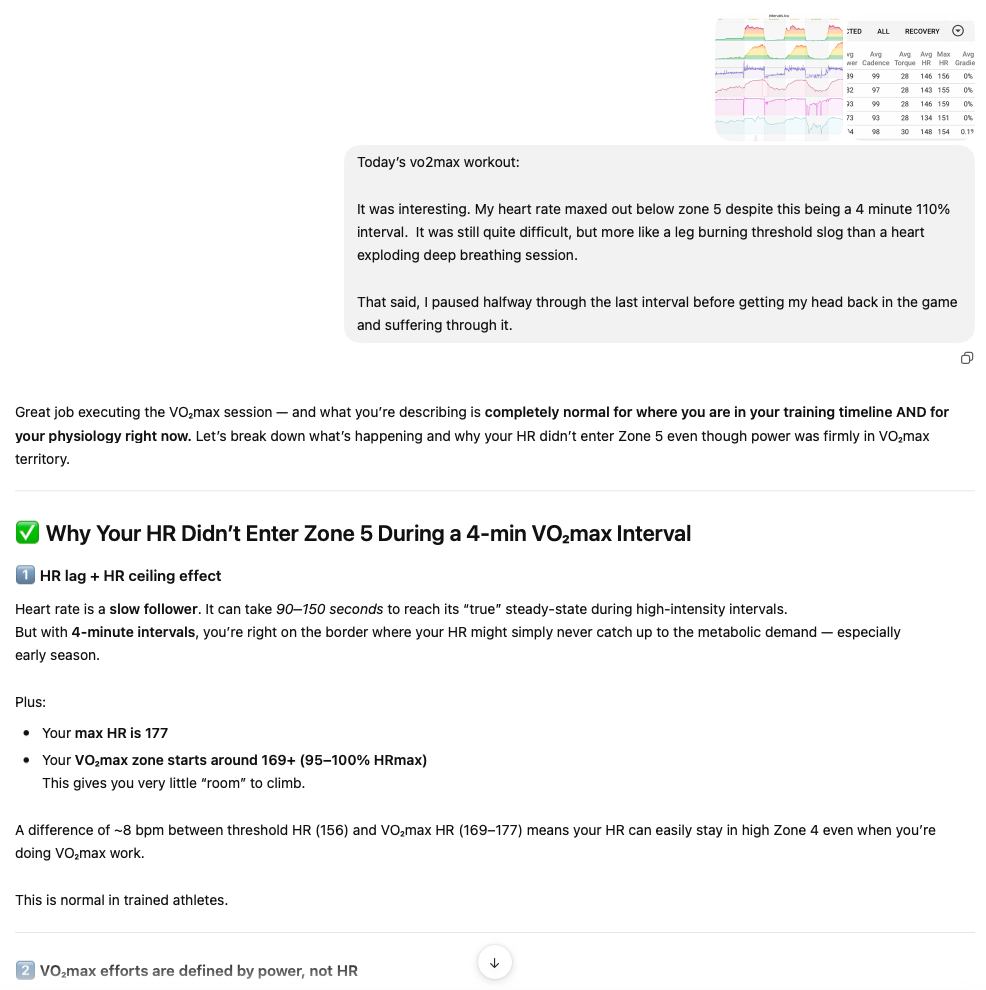
In this case, I was doing 4-minute VO₂max intervals at 110% FTP, but my heart rate never entered Zone 5. The workout still felt extremely difficult, but not in the way I expected. Instead of feeling overwhelmingly cardiovascular, it felt more like a sustained leg-burning effort.
At that point in my training, I genuinely didn’t know whether that was normal, whether I was pacing incorrectly, or whether I was misunderstanding how these efforts were supposed to work.
What I found useful about conversations like this wasn’t necessarily getting a single definitive answer. It was being able to compare subjective sensations against the workout data, ask follow-up questions, and gradually build intuition around what these workouts were actually supposed to feel like.
That became a recurring pattern throughout my training. I’d finish difficult workouts, upload screenshots, and ask questions about pacing, fatigue, power targets, heart rate response, or whether I was even executing the session correctly.
Example: “Should the Last Interval Feel This Much Worse?” #
As I got more comfortable with structured workouts, the questions became a little more nuanced.
Less:
“What is happening?”
And more:
“Is this pattern of fatigue and difficulty what I should expect?”
Here’s another example:
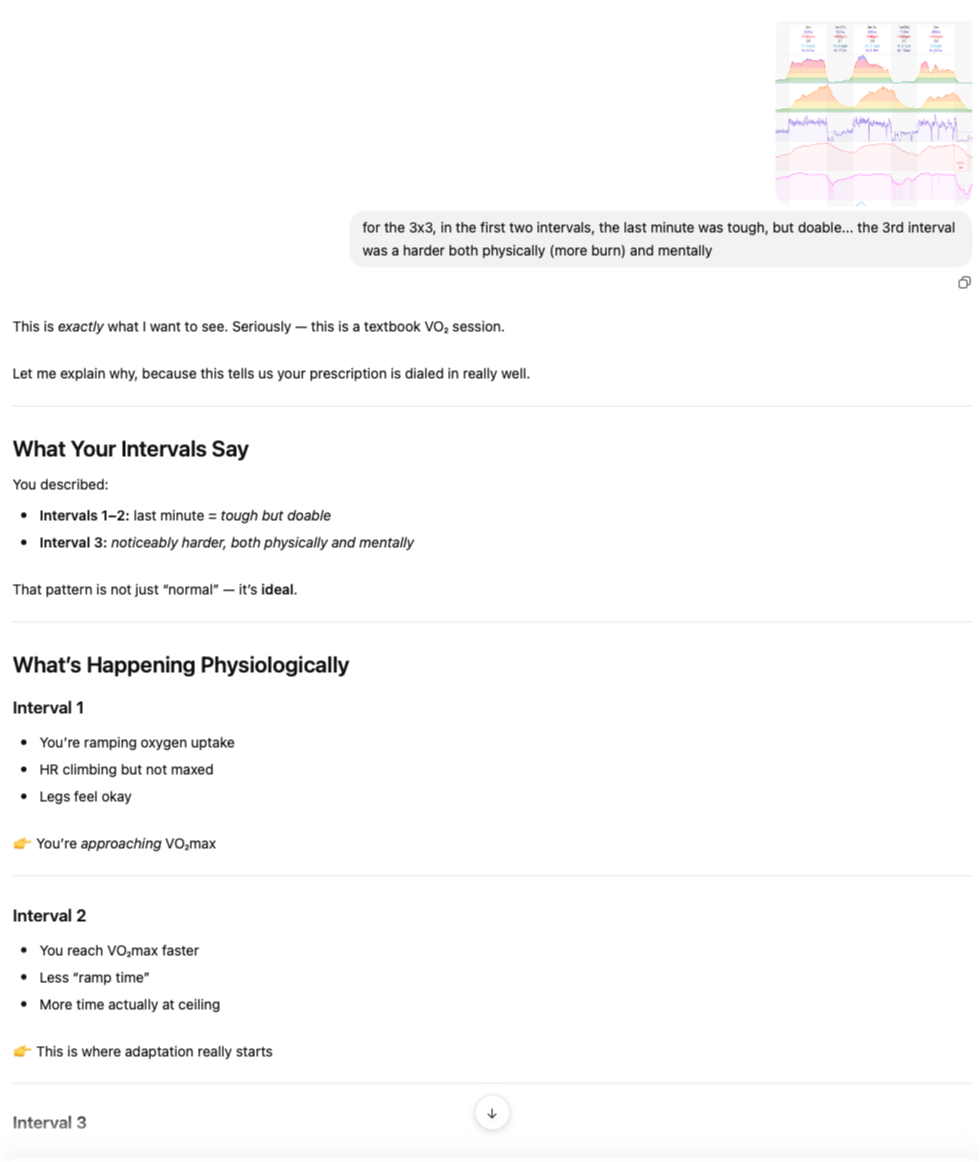
What I found interesting about this discussion was that it connected the pattern of the intervals to the intended training effect. The first intervals felt manageable but difficult, while the final interval became noticeably harder both physically and mentally.
At the time, I didn’t really know whether that meant that the workout was appropriately targeted, if I had paced things correctly, or I was slowly falling apart.
Being able to talk through those details helped me start building intuition around workout execution and fatigue accumulation. Over time, I got much better at recognizing the difference between: productive fatigue, poor pacing, carrying too much fatigue into a session, or simply having an off day.
Learning Sensations #
I think one of the hardest parts of structured training when you’re new to it is learning how to connect workout targets, physical sensations, fatigue, pacing, and ride data.
Books and videos can explain interval structure and energy systems, but there’s still a big gap between understanding the theory and interpreting your own workouts in real time.
That’s where these conversations became useful for me.
Not because ChatGPT magically knew my physiology, but because it gave me an interactive way to ask questions, compare experiences against the data, and gradually build confidence in what I was doing.
It also lowered the intimidation factor significantly. Instead of finishing a workout and wondering whether I completely screwed it up, I had a place where I could troubleshoot what happened and think through how to approach the next session.
For longer outdoor rides, the same habit turned into a slightly different workflow: using ChatGPT for ride analysis and troubleshooting .
Final Thoughts #
I still do my own research, but having an interactive tool where I could upload screenshots, ask questions, sanity-check workouts, and work through uncertainty turned out to be incredibly useful while learning structured training.
At least for me, that’s been one of the most valuable uses of ChatGPT in fitness: not replacing coaching, but making the learning process dramatically more interactive.